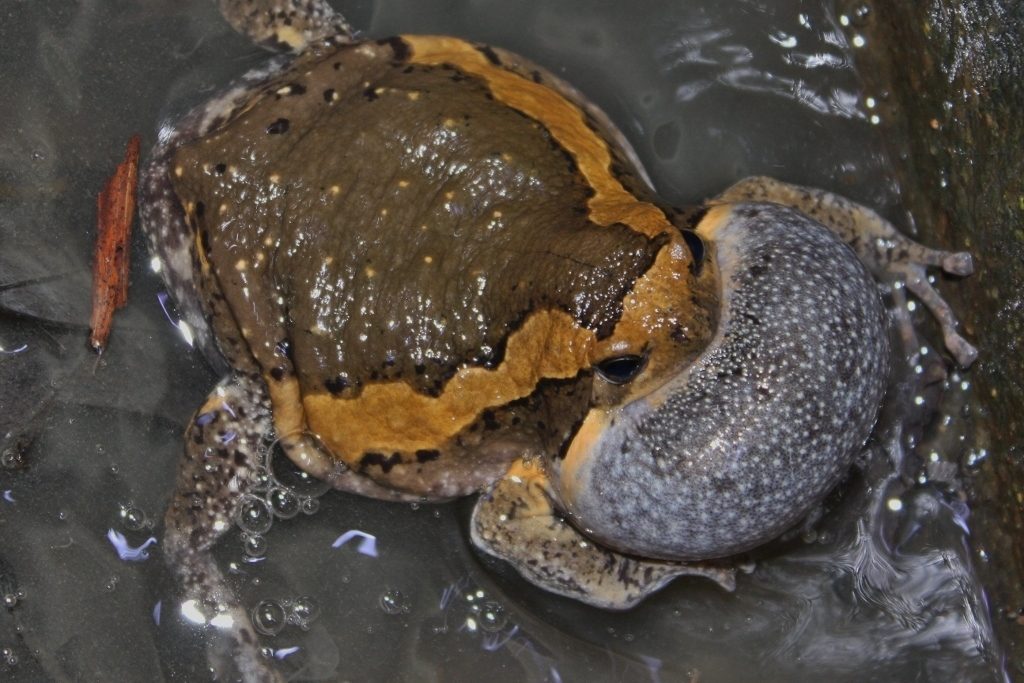
Photographed by an observer on iNaturalist and published under a Creative Commons licence; the photographer and the licence are named under the image. It is not an animal of ours, and no animal was handled by us to produce it.
The numbers
Temperature
One ambient band, 22–28°C. This sheet states no warm side, no cool side and no night figure, so none are shown. Same scale on every sheet here, so two species compare by eye.
The sheet states22-28 °C; tolerance 20-30 °C (species adapted to the tropics)
Humidity
The sheet states60-80%; misting 1×/day; shallow water dish renewed daily
UVB
The sheet statesPhotoperiod 12 h; low UVB (2–5%) beneficial (aids D3 synthesis); not mandatory if supplementation is correct
Identity
Adult size
The size the sheet states for a grown animal.
Why
Two drawings, because they answer two questions. The silhouette is at true scale against a 1.75 m person: it says how big this animal actually is, which no number does for someone who has never seen one. The bar under it is logarithmic and shared by every sheet here, so a 2 cm isopod and a 4 m python both stay readable on the same axis and two species can be compared at a glance.
How common this animal is
NOT a measure of how many are kept. These filings count animals shipped for any purpose, including the food trade and laboratory supply, and they are United States records only. The three largest volumes in the source belong to a food frog, a bait species and the standard laboratory amphibian.
US Fish and Wildlife Service LEMIS declared wildlife import and export records, as compiled in the received dataset
Enclosure and conditions
Enclosure
Drawn from the stated numbers. Only what the sheet states is drawn inside.
Why
The rectangle carries the exact width-to-height ratio of the figures above it, and the ruler under it places that width on the 0–250 cm scale every sheet here shares, so two species still compare at a glance. Nothing is added that the sheet does not name: a lamp drawn on a sheet that never mentions one would be invented equipment. What the sheet leaves out is listed rather than left blank, because an empty tank reads as « none needed ».
The sheet statesTerrarium 30×30×30 cm minimum for 1-2 individuals; deep substrate for burrowing; lid (occasional climbing)
What your climate adds
This sheet states a range to hold. Your local climate decides how much work holding it is. Pick the nearest city: nothing is sent anywhere, the choice stays in this browser.
Reproduction
Life course
Read from the lifespan and maturity the sheet states, for animals in care and not in the wild.
Why
The minimum commitment is the low end of that lifespan, and the reproductive window is what is left after maturity: both are subtractions on stated figures, not figures of their own.
Common health problems
Good to know
- Common native species in Thailand: often caught in the wild (WC); verify CB origin before purchase for health and parasitology
- Balloon inflation under stress: unique self-defence behaviour: release immediately if the animal inflates in hand
- Extremely loud call during the rainy season: in urban breeding, inform neighbours during the breeding period
- Common native species in Thailand — often caught in the wild (WC); verify CB origin before purchase for health and parasitology
- Balloon inflation under stress: unique self-defence behaviour — release immediately if the animal inflates in hand
- Extremely loud call during the rainy season — in urban breeding, inform neighbours during the breeding period
Common questions
Is it noisy?
The males can be very loud, a deep bellow especially in humid weather. Think twice if the tank will be in a bedroom.
Why is it always buried?
It is a burrower by nature and comes out mainly at night. Give it deep soft substrate and expect to see it in the evening, not the afternoon.
Can I handle it?
Only briefly and with clean wet hands. When stressed it puffs up and secretes a sticky glue-like substance, so wash your hands well afterwards.
Is it easy to keep?
It is one of the easiest frogs we sell. Crickets and roaches a couple of times a week, a water dish, and moist substrate is basically all it asks for.
What it needs
Every line above is deduced from a value this sheet states, and names which one. Nothing here is a general recommendation.
Sources
Others in this group
What this sheet states
This sheet states 5 of 7 of the fields this product runs on. What is missing turns something off: day/night engine and awake count on the globe, the diet section. We show the gap rather than fill it with a plausible number.
UVB is measured but does not count: it is absent from 421 of 678 sheets, and on most of them that is not a gap, since a nocturnal snake's sheet has no reason to state a UV index. Counting it would call the library incomplete without cause.