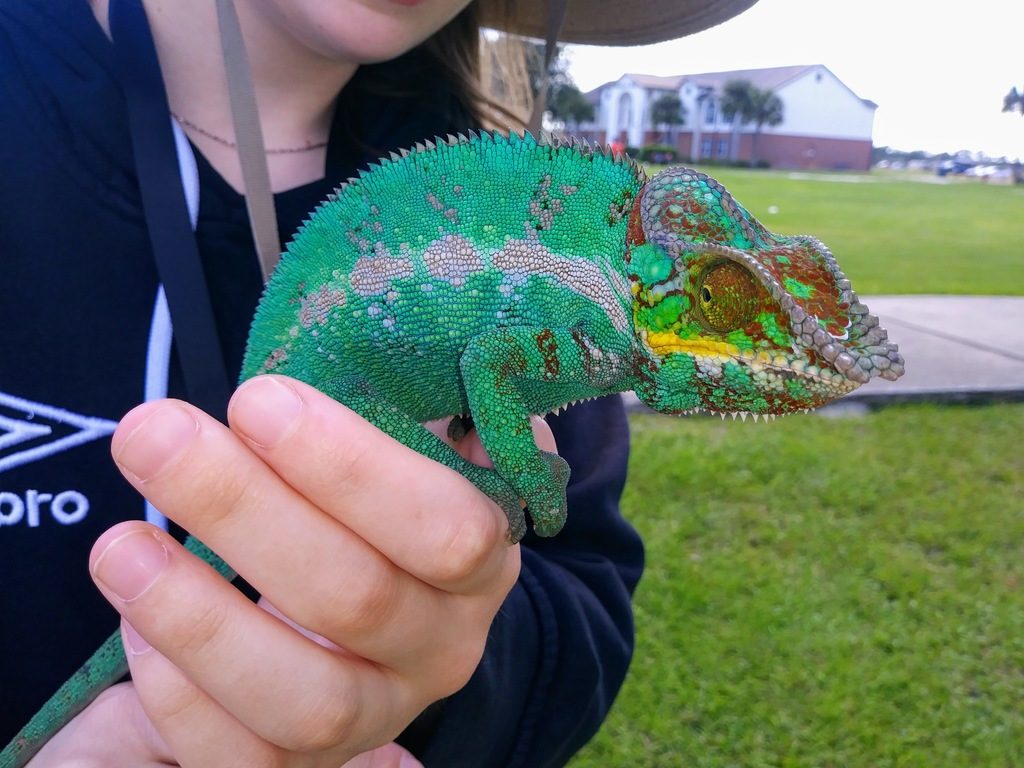
ภาพถ่ายโดยผู้สังเกตการณ์บน iNaturalist เผยแพร่ภายใต้สัญญาอนุญาตครีเอทีฟคอมมอนส์ ชื่อผู้ถ่ายและสัญญาอนุญาตอยู่ใต้ภาพ ไม่ใช่ภาพของสัตว์ที่เราเลี้ยง
ค่าหลัก
Temperature
The sheet gives a night figure only: 18–21°C. No daytime range is stated.
Why
Same scale on every sheet here, so two species compare by eye.
The sheet statesbasking 29-32 °C (85-90 °F) / night 18-21 °C
Humidity
The sheet states50-60% day, 75-100% night (mist)
UVB
The sheet statesT5 5–6% + bright 6500K lamp; replace ~6 mo
ข้อมูลชนิด
Adult size
The size the sheet states for a grown animal. This sheet gives a figure per sex; the one drawn is marked.
Why
Two drawings, because they answer two questions. The silhouette is at true scale against a 1.75 m person: it says how big this animal actually is, which no number does for someone who has never seen one. The bar under it is logarithmic and shared by every sheet here, so a 2 cm isopod and a 4 m python both stay readable on the same axis and two species can be compared at a glance.
How common this animal is
Relative Google search interest for the species as a pet, 2020. The scale is relative within the study: 100 is the most searched reptile it measured, not a count of animals. Reptiles only, and only the species the study measured. An absent value means the study did not measure that species, not that nobody keeps it.
Valdez JW (2021), Using Google Trends to Determine Current, Past, and Future Trends in the Reptile Pet Trade, Animals 11(3):676
NOT a measure of how many are kept. These filings count animals shipped for any purpose, including the food trade and laboratory supply, and they are United States records only. The three largest volumes in the source belong to a food frog, a bait species and the standard laboratory amphibian.
US Fish and Wildlife Service LEMIS declared wildlife import and export records, as compiled in the received dataset
ตู้เลี้ยงและสภาพแวดล้อม
Enclosure
Drawn from the stated numbers. Only what the sheet states is drawn inside.
Why
The rectangle carries the exact width-to-height ratio of the figures above it, and the ruler under it places that width on the 0–250 cm scale every sheet here shares, so two species still compare at a glance. Nothing is added that the sheet does not name: a lamp drawn on a sheet that never mentions one would be invented equipment. What the sheet leaves out is listed rather than left blank, because an empty tank reads as « none needed ».
The sheet states60 × 60 × 120 cm screen (males)
อาหาร
พฤติกรรมและการจับ
การสืบพันธุ์
Life course
Read from the lifespan and maturity the sheet states, for animals in care and not in the wild.
Why
The minimum commitment is the low end of that lifespan, and the reproductive window is what is left after maturity: both are subtractions on stated figures, not figures of their own.
ปัญหาสุขภาพที่พบบ่อย
เมื่อไรควรพบสัตวแพทย์
เกร็ดน่ารู้
- คาเมเลียนสีสวยที่สุด — สีขึ้นกับสายท้องถิ่น (Ambilobe แดง, Nosy Be ฟ้า)
- ตัวผู้สีสดกว่าตัวเมียมาก
- ยิงลิ้นยาวกว่า 1.5 เท่าของลำตัวในเสี้ยววินาที
- คาเมเลียนสีสวยที่สุด — สีขึ้นกับสายท้องถิ่น (Ambilobe แดง, Nosy Be ฟ้า)
คำถามที่พบบ่อย
สายไหนดีสุด?
การเลี้ยงเหมือนกัน — ต่างที่สีและราคา
จับได้ไหม?
ไว้ชม ไม่ไว้จับ
เหมาะมือใหม่ไหม?
ต้องดูแลละเอียด — น้ำและ UVB
อุปกรณ์ที่ต้องมี EN
Every line above is deduced from a value this sheet states, and names which one. Nothing here is a general recommendation.
- ตู้ตาข่าย 60×60×120
- UVB T5 + 6500K + อาบแดด
- ที่หยดน้ำ + เครื่องพ่น
- เถาวัลย์และใบไม้
- กล่องวางไข่ (♀)
- แคลเซียม+D3+มัลติวิต
- แมลงกัตโหลด
แหล่งอ้างอิง
ชนิดอื่นในกลุ่มเดียวกัน
What this sheet states
Every field this product runs on is stated here. That is not a claim that the values are right: it says what the sheet states, not whether it is true. Whether a human has read it is the badge at the top of this page.
UVB is measured but does not count: it is absent from 421 of 678 sheets, and on most of them that is not a gap, since a nocturnal snake's sheet has no reason to state a UV index. Counting it would call the library incomplete without cause.